|
| The gander who raised a brood atop our Bird Observation post, making a display of warding. This is not a threatening gesture, but a reminder to visitors that this is his family's territory as well as theirs. |
A British couple, tourists, were relaxing on the Adirondack chairs in the Natives section, enjoying the mountain scenery. I was coiling a hose nearby, when I heard rustling in the grass at the roadside. Two California quail peeked out, looked both ways, and crossed the road. Then three more. I waved to the couple, and we watched silently as a covey of fifteen or twenty quail bobbled over the road and disappeared into the brush on the other side. "Our State Bird," I whispered, and they nodded, their eyes wide with amazement.
Descanso Gardens is a special place to observe wildlife, and a special place for wildlife. Visitors can experience close encounters of many kinds. Even in the parking lot, flocks of exotic parakeets or red-crowned parrots can tear your ears with raucous calls as they fly overhead. Families of mule deer regularly traipse down the Boddy House hill for a browse at the tree shoots, or a sip of water from a sprinkler head, like it's their own private park. The deer don't live inside the Garden, but range through from the surrounding wild lands. They commute from their homes, just as gardeners and visitors do, to spend part of their productive hours in this fertile place.

Climate, geography, and our broad range of plants and habitats support organisms from molds and moths to mammals and mankind - and our organic ethic helps them thrive. Not all gardens have this ethic, which means careful and proactive stewardship of our varied soils and water courses. Organics means no harmful pesticides or herbicides; It means recycling plant wastes through our compost pile, rather than overloading the environment with artificial fertilizers. Organics unites all of our diverse habitats into a healthy, living whole that is greater than the sum of its parts: E pluribus, unum.
 |
| A volunteer displays a Western sphinx moth, found while weeding. |
While our habitats are healthy and dynamic, Descanso is not a natural environment. Soils, pests and dangerous or invasive species have to be managed to maintain an artificially beautiful equilibrium. Still, organisms that are native or naturalized here have full scope to engage in every aspect of life, which includes predation.
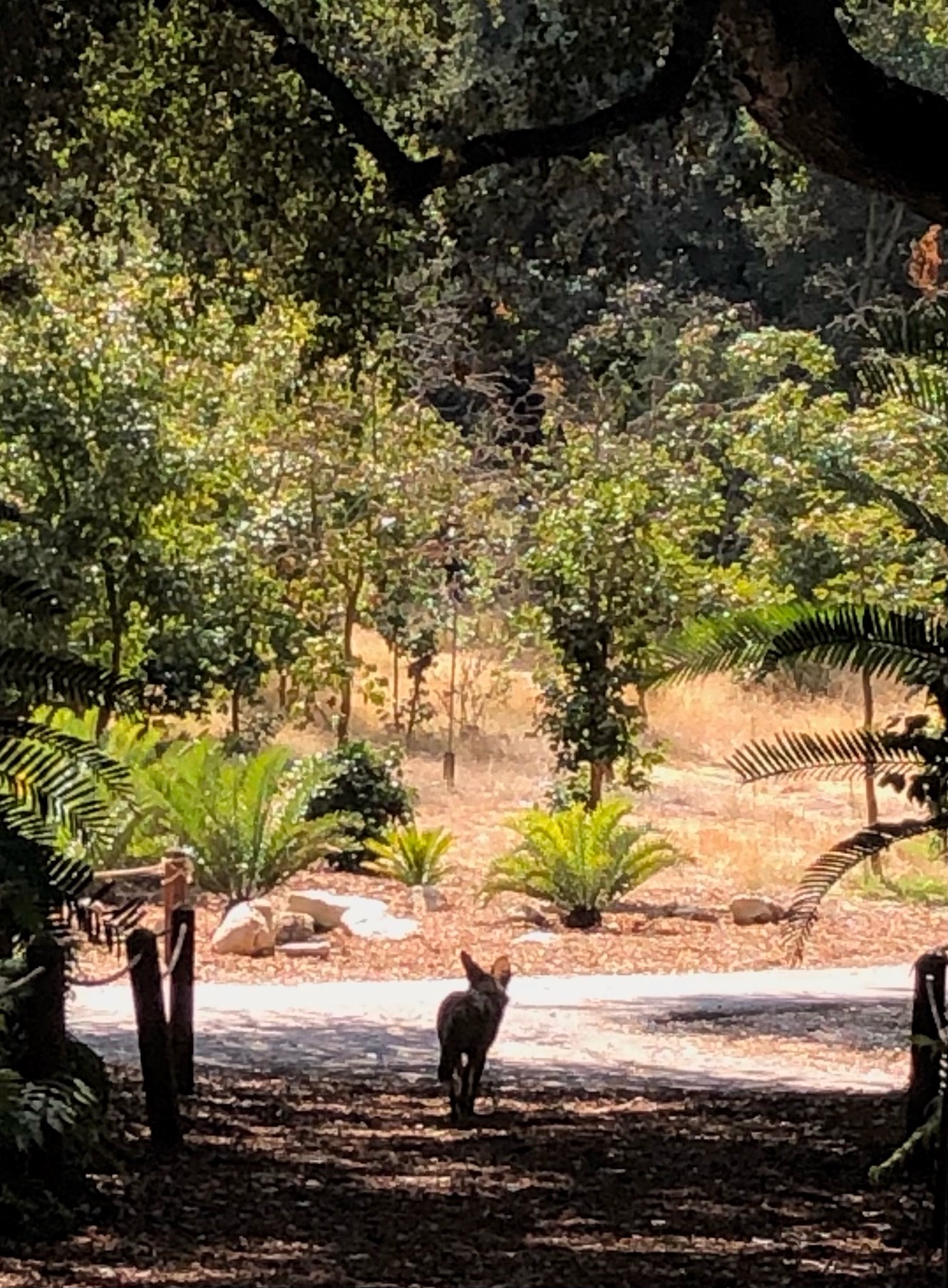
A coyote ambled out of the Ancient Forest on a hot afternoon. Seeing me on the path, perhaps recognizing me as no threat, she continued past and slunk into the shade of the Camellia Forest. An hour later, on the Promenade Pond, gardeners and visitors were watching the three Canada goslings in the water, wondering why their parents weren't with them. In a heart-stopping instant, the coyote sprang from the bushes, plucked a gosling from the pond, and melted back into the forest. Other visitors soon told us they had seen the coyote outflank the parents in the Oak Grove, separating them from their brood. We had watched these three goslings hatch, take their first swimming lessons, and gobble from the lawn. Now there were two. It was a solemn moment, but as natural as daylight. Coyote's gotta eat.
 \
\Coyotes, like the deer, are commuters. But some species are full-time residents, here to establish territories, hunt for food, and raise their young. This is their home, and we are privileged to share it with them. Owls roost in the Ancient Forest; red-tailed hawks dominate the sycamores in the Promenade and Rose Garden. A murder of crows haunts the picnic area the parking lot, and regularly skirmishes with the red-tail family, mobbing the hawks when they overfly the crows' turf. One American crow, dubbed Alfred, has a distinctive broken wing, perhaps from an aerial dogfight -- and is an unofficial mascot for the gardeners. Alfred has been here for many years, a respected member of his mob.
 |
| Crows have long memories. Alfred recognizes each of us, just as we gardeners recognize him. |
 |
| Resident red-tail stoically endures thunder and lightning, preparing for a downpour. |
 |
| Snakes eat other snakes, who knew? |